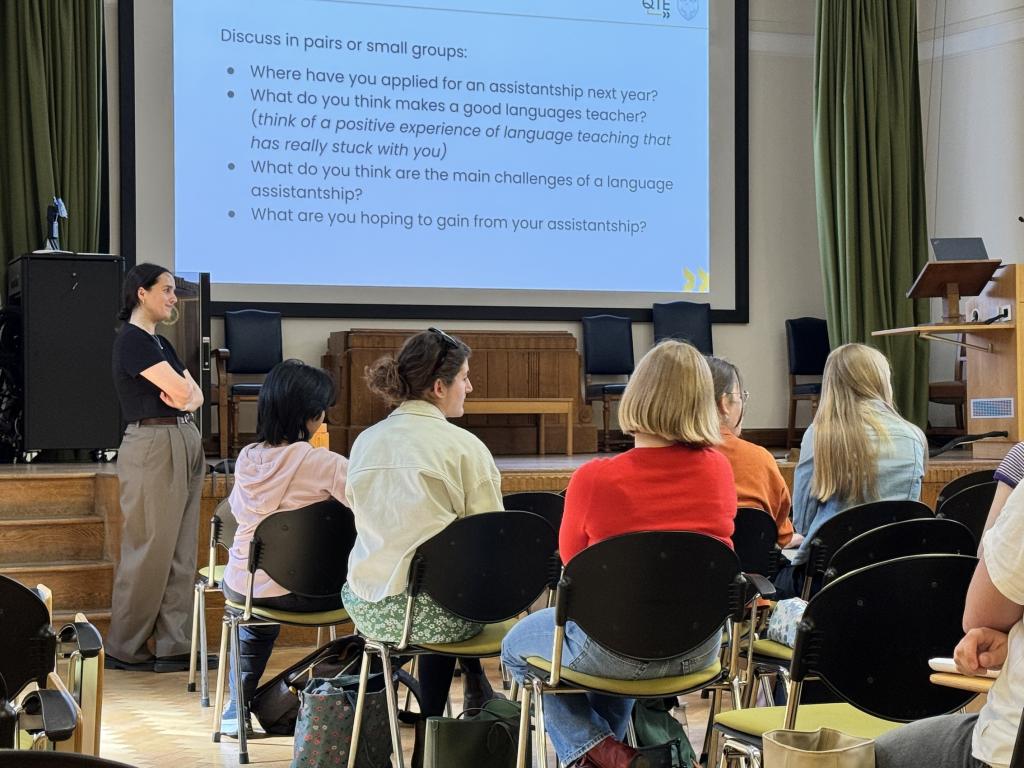
In May of this year, we were proud to run a pilot Creative Translation workshop at the Taylorian, for MML undergraduates about to embark on their Year Abroad. In a productive partnership with the Faculty, we were able to run an inspiring session that marks an important moment for The Queen’s Translation Exchange’s growth and for Languages advocacy in general, taking our successful method worldwide via our talented Oxford linguists. The idea was to train a cohort of ambassadors in the more literal sense of the term: overseas envoys for Oxford’s approach to language and literature.
A large part of QTE’s work is to normalise the idea that languages should be motivating, fun, and challenging just because the prize of mutual understanding is worth the hard graft of linguistic and cultural translation. Our Creative Translation Ambassadors programme, which has run so successfully in British schools since 2018, can be a key to unlocking a rewarding teaching experience for university linguists abroad, as well as for their pupils. At the end of a session, one participant studying German and Linguistics remarked, “I absolutely loved this session – I was undecided on whether to study or teach on my year abroad, but this might have persuaded me.”
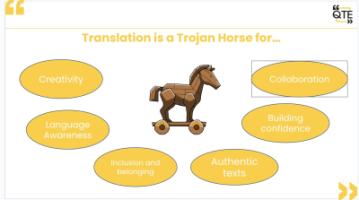
Meanwhile, the Year Abroad experience can be disorienting, initially, with university students turned teaching assistants often left to their own devices. Further, language learning in schools abroad often suffers from the same problems as in the UK: uninteresting, ineffective content. Empowering these students to engage in Creative Translation with their pupils can address both of these issues.
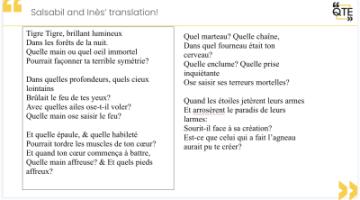
Creative Translation is a scaffolded, inclusive method that shows young linguists the joys and challenges of moving from the literal to the literary when making a foreign text one’s own. Creative Translation works well with a whole range of texts: poetry, fiction, non-fiction, lyrics, picture books. In May’s training session, we focused on poetry. In the same auditorium where students have their first lecture on versification, we discussed how to bring anglophone poetry alive in different target languages. First, we delivered a standard Creative Translation workshop from Spanish to English, using the poem ‘No sé por qué piensas tú’ by the Cuban poet Nicolás Guillén, so our new ambassadors could get a feel for the method. We then inverted the process: what is it like to teach the translation of an English text into your target language? We worked through the resource I had developed in Marseille as a teaching assistant myself, a workshop using William Blake’s ‘The Tyger’, and looked at the final translation my students had made. Students left the workshop enthused and focused: ready to build their own workshops out of their favourite literary texts in English.
This workshop also enabled us to strengthen our partnership with the Faculty. Professor Simon Kemp, Admissions Director at the Faculty and Fellow in French at Somerville, opened the session on behalf of the Faculty, and even shared his own year abroad experience as a young student of French. Embedding these creative opportunities in the experience of the undergraduate linguist can be transformative, and working closely with MML’s Year Abroad and Education offices made it possible. Following the success of this pilot session, we look forward to making Creative Translation a mainstay of the Year Abroad preparation, and developing further ways to align our work on outreach and advocacy with the Faculty.