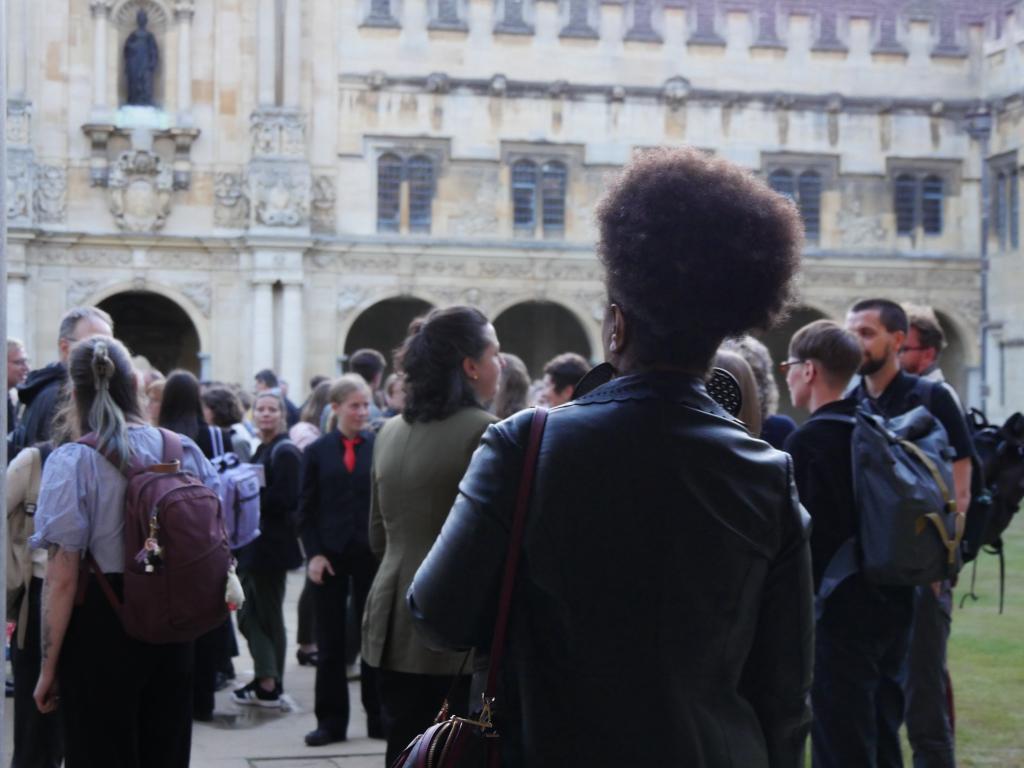
There are ways of writing that resist, are resistant and stem from resistance, resulting in texts which cannot be grasped or imagined through mere academic terminology. With her neologism escrevivência, a combination of the Portuguese words 'escrever' (to write) and ' vivência' (embodied experience), the writer Conceição Evaristo has endowed the world with a word that describes storytelling deeply rooted in embodied experience. She refers to a writing in which not only her existence as a Black Brazilian woman becomes narratable, but through her words the experiences of her enslaved ancestors are rendered legible, honoured, and thus finally accorded the dignity of remembrance. In the spirit of escrevivência, storytelling does not only stem from life but is powerful enough to connect lived experiences across times. This kind of storytelling has a sensual depth, in the sense of pain, but also resistance, through survival, through communities spanning centuries, with ancestors and descendants, through words and thoughts that elude white readers. These stories are not only not ours to tell, but also not ours to analyse, for we lack the knowledge to do so. As a White reader of Black literature, I read with the honesty that I can sometimes only catch a glimpse of the knowledge that lies in Black stories. I see this as a gift. The thing that makes my understanding appears when I dare to come to the text anew, without prior knowledge, to begin the reading again. Pondering, marvelling, learning. The question of how we can read Black German literature in German Studies was raised at the Annual German Studies conference, held in Oxford at St John's College in September.
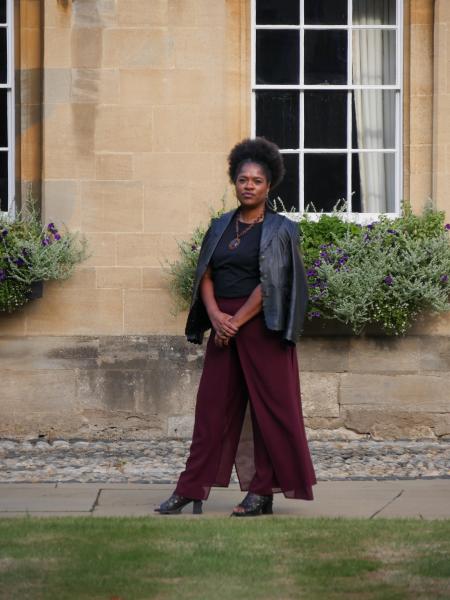
With this year's President's guest, celebrated Afrofuturist Professor Natasha A. Kelly, invited to Oxford by Kirstin Gwyer, we had a thinker who understands what and why we as White Germans and Germanists do not see when we think about Blackness. A selection of her long-selling and best-selling books were shown in the accompanying AGS exhibition at the Taylorian, alongside Goethe's lock of hair, among other materials that showcase Germany and its relation with the world. Cut off the head of this towering figure of the German-speaking literature by a witty barber who understood the Geniekult in Weimar Classicism as a business opportunity, the relic was donated to the Taylor Institution Library. Goethe’s hair sits framed, next to a pressed flower and two authentication notes. I seize the moment and ask Natasha A. Kelly, as a Black German woman, how she feels about her work being displayed next to the lock.
Natasha A. Kelly: Goethe’s hair is preserved as a relic of genius, a fragment of a body elevated into cultural memory. Beside it stood my book Schwarz. Deutsch. Weiblich, in which Black hair appears repeatedly as a site of struggle, beauty, politics, and belonging. This proximity exposes a striking asymmetry: one strand of Goethe’s hair is archived and revered simply for what it is, while Black hair has historically been burdened with meaning, endlessly scrutinised, regulated, and contested.
Perspectives like Kelly’s, with their accompanying insight, are an important part of German culture – but which German Studies still lacks. In her book Schwarz. Deutsch. Weiblich, an excerpt of which was published in English for the first time in the exhibition catalogue, Kelly tells ‘stories, stereotypes, and acts of resistance tied to Black hair – stories that are rarely afforded the dignity of preservation in the same way Goethe’s lock of hair has been.’ For her, the juxtaposition of her works with Goethe’s hair creates ‘a dialogue between body and text, between relic and narrative’ which shows the ‘canonisation of whiteness and genius’, revealing ‘how deeply these questions of value, memory, and representation are embedded in our cultural frameworks, surfacing even when not consciously curated.’ With her works, Kelly insists ‘on presence of Black voices, Black women’s experiences, and the histories inscribed in something as everyday and yet as charged as hair. Ultimately,’ she says, ‘the encounter pushes us to ask: whose stories do we keep? whose fragments are deemed worthy of cultural memory? and how might new constellations — even accidental ones — allow us to imagine different futures of heritage and belonging?’
The urgency of these questions continues to resonate long after, echoing into the silence with which German Studies respond to their Black culture, for Germany has a long Black history that white Germanist scholarship has consistently overlooked. When the eminent Black German philosopher Anton Wilhelm Amo died in the 1750s, Goethe was still a child. Since July this year, the Anton-Wilhelm-Amo-Straße in Berlin has commemorated this significant figure in German intellectual history. Yet among the passers-by who read the street sign bearing Amo’s name, few likely know who he was. Authors like May Ayim and Sharon Dodua Otoo, whose works have increasingly been embraced by German readers in recent years, appear in academic analyses, however, primarily as objects of study, interpreted through a white lens. How can German Studies adequately recognise Black Germans and their role in German-language literature and culture? Questions such as these were addressed at the AGS, in a conversation between Natasha A. Kelly and Kirstin Gwyer, which can be watched (again) here, and in the panels curated by Gwyer on Black Literature and Culture in German.
‘Black German literature narrowly is positioned at the interstices of German, European, African American and diasporic African cultural production and falls between German studies, comparative literature, critical race theory, and postcolonial studies. It relates fluidly to all but isn’t recognized by any, least of all a Germanistik whose self-perception is still white', Gwyer concludes the problem within her discipline. She says that it is 'high time to bring Black German literature into German studies, recognize its significance within German literary history, and study it not as a trend or phenomenon but as literature.' The discussions in Gwyer's panels therefore also revolved around the following questions: How do we contribute to the work, as white literary scholars? Through whose knowledge system do we read Black literature? Who are we when we come to these texts and who are we afterwards? Where does our imagination come from? What limits our imagination? Why do we choose Black literature as our research interest? Where do we come from in that choice? And, most importantly, with whom do we collaborate?
It is not as if there are no Black Germans, and among them literary scholars whose knowledge on the topic is ahead of ours. We, as white Germanists, have simply not paid any attention to them and their works so far. At this moment in German Studies, it is becoming painfully obvious: We are missing generations of white academics who were taught by Black professors.
Looking to the possibilities of the future – as Afrofuturism proposes, while white discourse is still preoccupied with its own (de)colonialism – a different approach becomes possible: one of togetherness. As white scholars, we have yet to find out how we position ourselves in this conversation. For Natasha A. Kelly, in her life, sisterhood is key.
Natasha A. Kelly: As the youngest of four girls, I was born into sisterhood. For me, it began not as a concept but as lived reality: being cared for, guided, and sometimes challenged by the women closest to me. That experience gave me an embodied sense of what solidarity, trust, and accountability mean. Later, as a Black woman in Germany, I came to understand sisterhood as even more than family ties. It became a political practice, a lifeline in communities of Black women who shared knowledge, resilience, and joy in a society that often tried to render us invisible. Sisterhood has guided my decision-making by reminding me that I am never acting alone. Every step I take—as an academic, an artist, or an activist—is in dialogue with those who came before me, those who walk beside me, and those who come after me. It is about care, but also about responsibility: carrying one another, amplifying one another, refusing to let each other be silenced.
Against this backdrop, I ask Kelly the painful question: Can we be sisters across racial lines?
Natasha A. Kelly: I believe it is possible, but not automatic. History shows us that “sisterhood” has too often been claimed in ways that centre white women’s experiences and overlook or dismiss the struggles of Black women. For true sisterhood to exist, there must be honesty, listening, and a willingness to confront privilege—not as a one-time gesture but as an ongoing practice. Only when differences are acknowledged, and when solidarity does not demand sameness, can we truly meet each other as sisters.
I talk to her a few weeks after the AGS, and a lot has moved forward in Kelly's life again. She is now Professor of Global African Arts at the University of Bayreuth and Director of the Iwalewa House. The opportunities Kelly's new role opens up for Black art, culture and knowledge production will become visible in the years to come. We can look forward to bearing witness of change induced by Kelly's work. I ask Kelly to give us Germanists at Oxford, whom she had the opportunity to meet and educate at the AGS, something to take along.
Natasha A. Kelly: My advice would be: stop treating Black German Studies as an optional add-on to the so-called “main” tradition of German Studies. Black German voices, histories, and cultural productions are not peripheral; they are central to understanding Germany as it really is, in all its complexity. To ignore them is to reproduce a false, whitewashed picture of German culture. Oxford, in particular, has the opportunity and the responsibility to create space for these perspectives—not by appropriating our stories, as has too often happened in the United States, but by making sure that Black German scholars are the ones shaping the field. This also means being in dialogue with Black Studies in Britain, recognising the specific histories of colonialism, migration, and resistance here, and learning from the work of Black British scholars who have long interrogated what it means to belong, to be excluded, and to reimagine the nation. In short: listen to us, centre our work, and resist the temptation to turn Blackness into an object of study detached from Black people themselves. If German Studies at Oxford wants to be truly rigorous, it must include Black German Studies not as diversity decoration but as an indispensable part of the discipline.