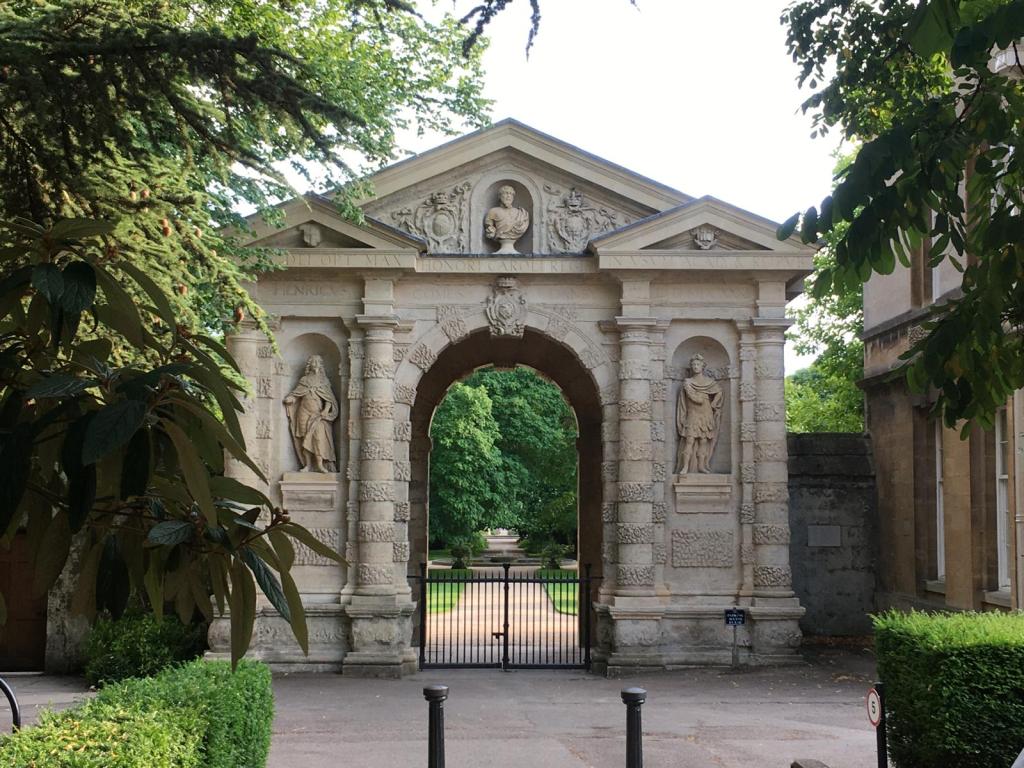
Welcome to the Michaelmas 2025 edition of the Polyglot. This term Modern Languages moved home, one of seven Humanities faculties to relocate to the Schwarzman Building. Our faculty members and students have helped to bring this impressive building to life. The proximity of so many people working in the Humanities augurs well for future collaborations and a growing sense of common cause among disciplines at a time when Modern Languages programmes, and the Humanities in general, are under threat across the UK. We look forward to welcoming many of our alumni to the Schwarzman over the coming years.
Coinciding with our new premises, we have just launched a new Masters programme in Creative Translation, spearheaded by the Schwarz-Taylor Professor of German Language and Literature, Karen Leeder. Information about it can be found here. Creative translation is prized at Oxford and Jack Franco, who has been working with the Queen’s Translation Exchange talks in the Polyglot about training our own students to become Creative Ambassadors during their years abroad in schools throughout the world, fostering joy in languages and helping pupils to think critically about words and the way we use them.
Tim Morris, who read French and Spanish at The Queen’s College, took a year out in a French lycée in the Pyrenees, graduated in 1981, and then joined HM Diplomatic Service. He served in Japan, Spain, and Portugal. He was Ambassador to Morocco and Mauritania and South Sudan, Head of Mission in the Democratic Republic of Congo, led the International Organisations Department in the Foreign and Commonwealth Office and was Coordinator on the Sahel and Envoy to the Peace Negotiations on South Sudan. He is now a business consultant, company Chair, and Chair of Trustees at a disability inclusion charity, CBM UK. He reflects here on what languages taught him throughout his career, but also about the severe consequences of a language deficit in the UK.
We were delighted to welcome multi-award winning Brazilian activist Djamila Ribeiro to Oxford to give the 2025 Taylor lecture. Emily Dicker recounts the thrill of hearing her talk, particularly for women in the room who felt empowered by much of her discourse.
The question of how we read others is at the heart of doctoral student Santhia Velasco Kittlaus’ reflection on and discussion with Natasha A. Kelly, this year’s President’s Guest at the Annual German Studies Conference in Oxford. The renowned Black German author and academic was struck by seeing one of her books alongside a lock of Goethe’s hair in the Taylor Institution.
Ian Grainger read Law at Oxford but his enthusiasm for languages is what drives him. His love of all things Italian (from literature to food) has offered him many enjoyable moments—to the extent that he coins the neologism ‘italofreak’ to describe himself. His linguistic and cultural skills led him to act in cases about Parmesan cheese or luxury handbags but his real desire is to help others with a similar passion—and he has already donated many of his Italian books to Oxford’s libraries where we hope they will be used by generations of students to come.
Two years in and the Oxford Scandinavian Studies Network is expanding its reach and activities through in person and online events. It is an illustration of a very successful graduate initiative presented here by one of its founders, Sarah Fengler.
We are fortunate, at Oxford, to have links with several foreign universities. The Université Libre de Belgique (ULB) is a valued partner for us thanks to the Fondation Wiener-Anspach which allows our students to spend a year or two in Brussels whilst we welcome graduates from Brussels. The FWA also funds joint Anglo-Belgian research projects. At a time when public funding is shrinking, this is particularly precious. Two recent postdoctoral researchers, Dr Nora Baker, who is currently in Belgium, and Dr Nicolas Duriau, who has been at Oxford, express their gratitude here.
Our greatest assets are our students. Professor Katherine Ibbett, outgoing director of graduate studies, one of the core positions in which academics serve within the Faculty, alongside their teaching and research, celebrates our students but also takes stock of the dwindling resources available in funding terms which mean that, for purely financial reasons, many successful applicants are unable to take up places to prepare an advanced degree.
In light of those dwindling resources, I am particularly pleased to share the news of a newly endowed graduate scholarship in Spanish Studies, thanks to a very generous gift of £1m from Rosemary Edwards, the sister of the late Dr John Edwards who was a faculty fellow in Spanish. Such generosity enables us to continue for and with our students, and to ensure that our field thrives in the future.
Professor Phillip Rothwell
Chair of the Faculty of Medieval and Modern Languages