
I was asked to write this piece because of a mistaken assumption that I had read Modern Languages at Oxford. Given my enthusiasm for (and recent peripheral involvement with) the study of Modern Languages here, the assumption was an understandable one but it was wrong because I read Law (at Univ) from 1974 to 1977. I did Latin to A-level and a year of French after O-level: and as was then required, I had to sit entrance papers in both of those languages as well as in History. But I studied Law for the simple reason that I wanted to become a barrister. After three very satisfactory years at Univ and a year at Bar school, that basic ambition was achieved and I set about starting a career in a legal profession and a working world which was in some basic respects the same as it is today but which in others would be almost unrecognisable to modern beginners.
I became the eighteenth tenant in a common-law set at One Essex Court in the Temple. It had strong commercial ambitions but only one QC, the head of chambers. Today, the same set has (I think!) 135 tenants of whom no fewer than 56 are in silk. Those simple figures tell their own story of change and success over time: but one also has to throw in a lifetime of technological and regulatory alterations. I played my own small role, practising widely in civil and commercial matters, both in court and advising clients in conference and on paper. But I never sought silk, applying instead to sit part-time as a Recorder, essentially in crime but also doing a small amount of civil. I preferred the judicial role and in 2009, after 6 years as a Recorder, was made a full-time Circuit Judge sitting only in crime. I sat in Reading. No judge can (or should) escape the vast modern workload of sex and violence but in addition to that, my commercial background led to my being slightly typecast: I did loads of fraud work, money-laundering, confiscation of the proceeds of crime and in short anything else paper-heavy and liable to induce a headache!
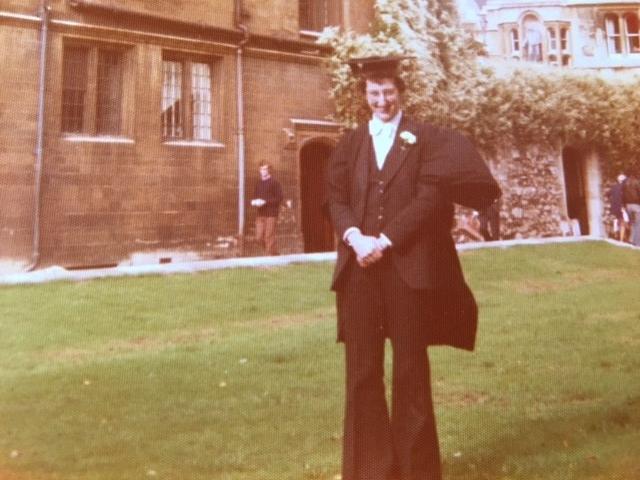
So far, however, one fundamental aspect of my life (some would say the defining aspect) has not been mentioned. I should stress that I retain the highest admiration for the Bar and have done my bit to serve it over the years. But after a few years in practice, I began to feel that I was lacking, or had missed out on, something in life: not something more intellectually demanding than Law, the study of which has grown ever more challenging, but something (for want of a better expression) more nourishing. I never went to Italy until after I started practice but as soon as I did, I got the bug in a big way. I began to travel there a lot, on my own or with family and friends and all over the peninsula. I also began to learn the language, initially at home and at night-schools and other institutions, for example the Dante Alighieri Society and the City Lit. Eventually, in 1995, I started a BA in Italian through the (then) External Programme of the University of London. This was an old-fashioned language and literature degree (with exams) which suited me down to the ground, as indeed did the business of remote learning for one’s self, a process which is second nature to barristers. I’m afraid I was a real enthusiast (or Italofreak?), so that, for example, even though one only had to read selected cantos of the Divina Commedia, I read the lot. The BA took me 6 years and then I immediately plunged into an MA in Italian Studies at UCL. This 2 year course was different because one had actually to turn up (almost always in the evenings) to discuss things with tutors and other budding linguists. I loved the whole business, both what one studied and the people one met.
The two degrees and lots of travel left me speaking reasonable Italian. I also began to meet Italian lawyers. Every year, through the “Young European Lawyers Scheme”, chambers hosted young lawyers who were spending 6 months in London, 4 months on a legal English course, followed by short periods in a solicitors’ firm and barristers’ chambers. Every year, I would say “I’ll have the Italian” and through that, improved my Italian in another context and made several extremely good friends into the bargain.
My motives for learning Italian had never included any legal professional ones – mine had been a pure if irresistible passion! – but once others realised that I could speak the language well, Italian began to play a growing part in my legal life. I knew next to nothing of Italian law but acted for Italian clients suing or being sued in this country. These were usually Italians with little English but there was no stereotypical situation. I acted in cases about Parmesan cheese, expensive Italian handbags, wine, steel-making machinery and Lord knows what else, both in court or else in the increasingly common world of mediation.
Finally – and in some ways most rewardingly – I often taught at Italian universities, usually about English constitutional matters or about practice and procedure in our legal system. I taught at Genova, at Alessandria, at Macerata and (after I had retired from the bench in 2019) taught a week’s course on “Inglese giuridico” to graduates at the University of Pavia. Such teaching was mostly in Italian: the Pavia course was theoretically in English but inevitably, as one attempted to explain various complicated and off-beat English legal concepts, one ended up having to use both languages.
I could write so much more about my passion for Italy and its history, language and literature. For example, I have not even mentioned the excellent British-Italian Society of which I have been a Life member for many years. But to come full-circle to Oxford, I am now doing my humble best to help with the promotion of teaching and research in Italian here. I have decided that the Law can be left to fend for itself, at least in Oxford. Most immediately, I am trying to find a suitable home for my extensive collection of books on Italy. Some have gone or are going to the Taylorian and to other parts of the Bodleian but the task of placing the balance is proving challenging. Quite often, academics depressingly tell me that “Students don’t read books any more”. Shame on us all if, somehow or other, technology has indeed brought us to such a pass!