The Year Abroad has opened up many opportunities for me to strengthen my language skills and deepen my knowledge of the culture at the heart of my studies. Perhaps the most invaluable part of this experience has been being able to witness Czech culture, history and language come alive. Modern languages are a special subject because the experts are ordinary people, which is why the cultural immersion at the centre of the Year Abroad is so important.
I am a third-year student of French and Czech and I am currently volunteering at a secondary school in Brno, Czech Republic, as an English-language assistant. Brno is Czechia’s second largest city after Prague and is located in the Moravian region to the east of the country. I made the decision to spend the whole academic year here as opposed to splitting my time, because I wanted to settle into the city and observe the passage of the year upon a place I would grow familiar with.
I arrived in Brno in early September when the city was still basking in gorgeous summer sunshine and the sky was clear and blue. My first impression was how full of history every street in the city was. The most famous places across the city are the Cathedral of Saint Peter and Paul (Katedrála svatého Petra a Pavla) and the medieval Špilberk Castle (Hrad Špilberk).
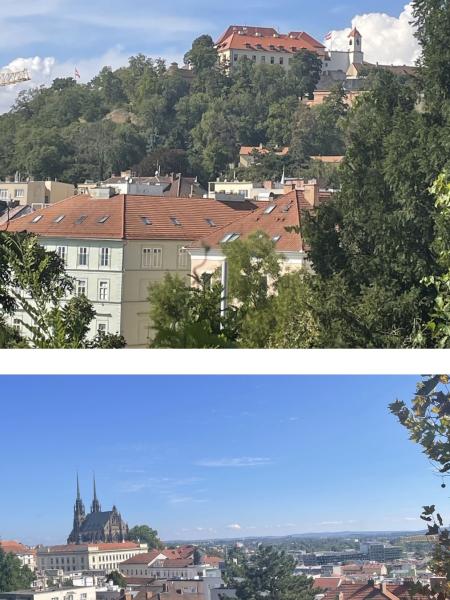
In October, I climbed the cathedral towers (added in the early 20th-century) to see the bells and the breath-taking view over Brno. The view from the top of the cathedral highlights how, although Brno is a relatively large city, it is nevertheless compact and, for this reason, is often referred to as a large village (velká vesnice).
The second thing I noticed when I first arrived was the seamless way the urban and the natural were woven together throughout the city. Hrad Špilberk sits upon a hill that maintains much of its natural beauty and charm, while the city boasts multiple green parks like the largest Park Lužánky or my favourite, Kraví hora, where I often go for a stroll. These spots are in the centre, but still Brno has more to offer.
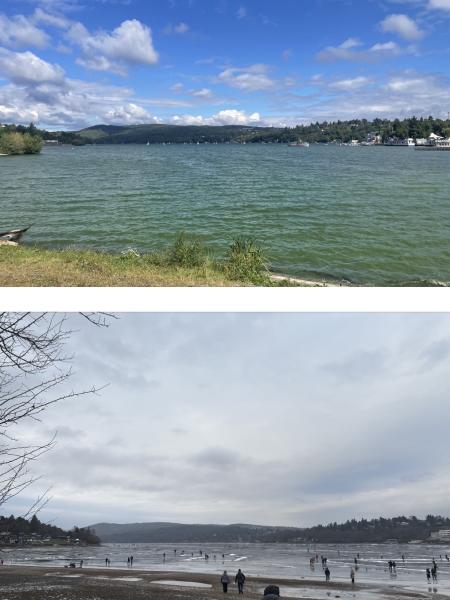
Take the tram north and you end up at the wonderful Brno dam (Brněnská přehrada, or ‘Prýgl’ in the local slang, Hantec). One of the perks of spending the year here is I have had the chance to watch the dam’s geography change with the seasons. In September, it was dotted with boats sailing along the deep blue waters and the surrounding landscape was awash with luscious forests and green hills; meanwhile, in the winter months the dam froze over and people played on the ice sheet as the banks of the dam were covered in a blanket of snow.
The change in seasons has been visible not just in nature, but also on Freedom Square (Náměstí Svobody) where the city marks the important dates of the year. November the 17th is one such date: a bank holiday known as the Day of Struggle for Freedom and Democracy (Den boje za svobodu a demokracii) which commemorates the start of the Velvet Revolution, the end of the Communist regime, and the transformation into a democratic country. I had learnt about this historic moment in class in Oxford and I was eager to see the commemorations for myself — so much so that, in my excitement, I arrived several hours early!
The afternoon began ceremoniously, with student representatives from each of the city’s multiple universities laying wreaths in memory of the crucial role students played in the fight for democracy in 1989. However, it was the evening programme that left a lasting impression on me. As the evening grew darker, the square began to fill up with more people. Then, at 17:11, the crowd sang “A Prayer for Marta” (Modlitba pro Martu). It was a moving tribute to Marta Kubišová, who sang this song in Prague during the Velvet Revolution: a celebration of hope for freedom and for the future. Being stood in that crowd brought shivers. It was an unforgettable experience, where events I had learned about in a lecture became palpable and real.
This National day was also marked in a unique way in the school where I volunteer. For one day, the school was transported back to Communist times: banned books were taken out the library; the Internet was shut off and computers disabled; teachers and students addressed one another as “comrade” (soudruhu/soudružko); and communist music was blasted through the speakers in break times.
However, where oppression reigns; rebellion arises, as was demonstrated on this day. Both students and teachers took part in rebelling against the system. During one break, some of the English teachers worked together to stand on chairs and disconnect the speaker above the door in the office to silence the zealous anthems of the Communist regime. While students handed out leaflets demanding freedom and calling on others to come together in the name of democracy, mirroring the actions taken by students in 1989. Although this day was only a simulation, the demonstrations of defiance felt genuine, especially from the teachers who had experienced this painful period in their nation’s history.
Christmas in the school was similarly enriching, as I got the chance to witness Saint Nicholas’ Day (Mikuláš). This tradition involves Saint Nicholas making his way around school with a legion of angels (andělé) and devils (čerti) to separate the good children from the bad. Think of it like Father Christmas’ naughty/nice list come to life! The tradition was performed by the older students who walked around clanging chains, before entering a classroom where the students inside had to perform a carol (koleda) or be taken away in a sack (I should stress, no children were hurt in the process). In my fear of being bundled into one of these hessian sacks, I too ended up memorising a traditional Czech carol, though thankfully it was not needed: I must have been good! (You can see the school’s film of some of the events here: https://www.instagram.com/reel/DR7AFI-CAhE/?igsh=MTdoZnQ2cHdncndpMA==)
Ultimately, I have greatly appreciated my time in Brno so far. I have learned more about Czech culture by living within it. While my first-hand exposure of many of the traditions might prove useful in exams, these experiences will doubtlessly remain with me beyond academia. I still have lots to look forward to as spring makes its welcome arrival and when I return to my Czech-language classes, I will have an armoury of unforgettable Brno experiences and expressions in tow. Ahoj!