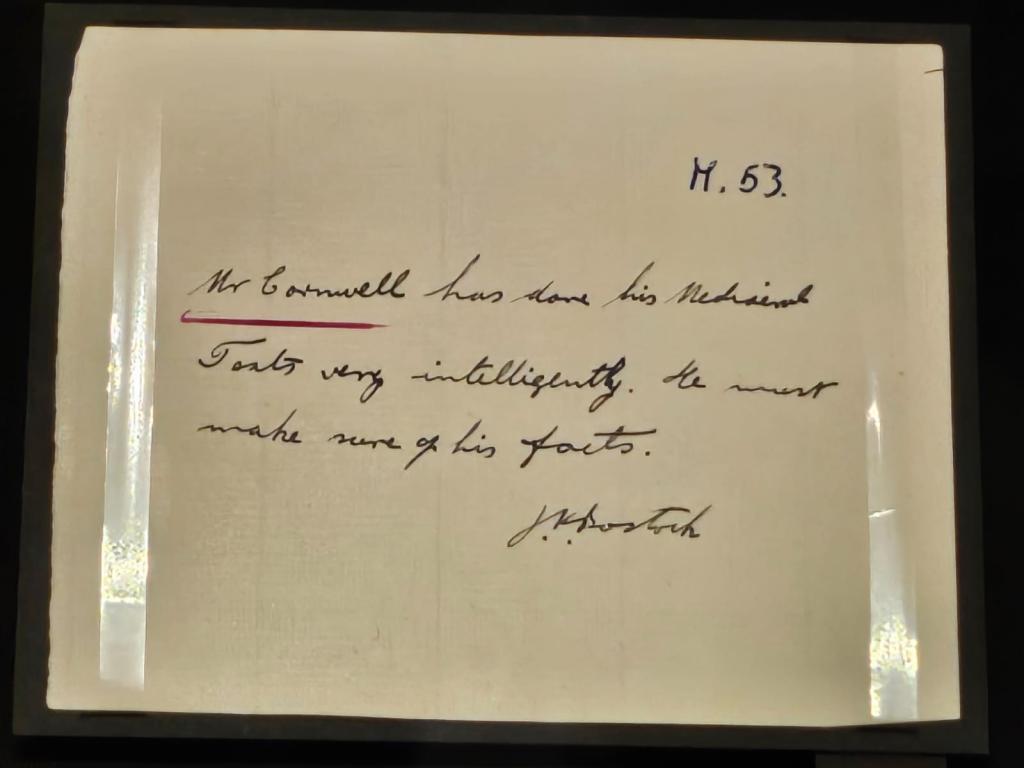
“Mr Cornwell has done his Mediaeval Texts very intelligently. He must make sure of his facts./ J. K. Bostock”. The note, by J. Knight Bostock (1893-1963), lecturer then reader in German at Oxford, and author of A Handbook on Old High German Literature is currently on show as part of the Tradecraft exhibition (until 6 April) at the Weston Library, on loan from Lincoln College archives. David Cornwell, the object of the exhibition, is one of our alumni, better known as John Le Carré[1]. He was fluent in both German and French and a strong defender of languages. There is much to enjoy in an article he wrote for The Guardian in 2017 and which you can find here: https://www.theguardian.com/education/2017/jul/02/why-we-should-learn-german-john-le-carre
Cornwell’s career as a teacher, diplomat and intelligence officer, but also his subsequent life as a bestselling novelist, all bear witness to the importance of languages for his life and work. With their wide variety of career paths and achievements, it is always inspiring to hear about what our former students have become. This issue gives us an occasion to catch up with three recent graduates. Rosie Gaunt (who read Italian and Latin) now works for Manolo Blahnik and reflects on how her practise and love of languages has accompanied her throughout as she strives to make a difference in the world both in the field of traditional luxury craftsmanship and with a non-profit organisation doing work in schools and beyond.
In Geneva, Pauline Lemaire (who studied French and Philosophy) is using her linguistic skills but also her intercultural sensitivity to great effect, working for a prestigious private bank and advising wealthy families thanks to an understanding of their internal ecologies.
Franklin Nelson (who read French and Portuguese) went down from Oxford and won a prestigious internship at The Financial Times, a periodical for which he still writes. His interest in literatures of the global South leads him to interview contemporary writers—including those who come to Oxford to lecture or present their books. We caught up with him just as he was off to talk to the Chancellor, William Hague, who dropped in to the Faculty earlier on this term and expressed his support for Modern Languages. We are hoping he will spearhead some much-needed fundraising.
Cláudia Pazos Alonso, herself an Oxford Modern Languages graduate, has just taken early retirement. Her former tutors in French and in Portuguese attended a leaving event for her at Wadham College, as did some of her students. They celebrated the impact she has had on the field of Lusophone studies in the United Kingdom and beyond.
No two years abroad are alike. Jamie Hopkins is teaching English as he practises his Czech on a daily basis, making the most of his time in Brno, taking part in festivities (including ones which re-enact opposition to communism) and enjoying the landscape and monuments. In Bamberg, alongside her studies, Tara Williams set out to write poems and prepare digital illustrations as she worked through texts by E.T.A. Hoffmann. A publication and a prize bear witness to the success of her project.
As we send our students out into the world, sometimes, like Tara on her year out, to universities overseas, we also welcome scholars from a variety of institutions. Among those who spent some time in Oxford this term is Tony Gheeraert, a distinguished professor from the Université de Rouen in Normandy. We caught up with him for a quick conversation about his teaching, his time in Oxford and his literary recommendations both for classics and overlooked works.
Because so much literature focuses on exceptional experiences and people, Holly Langstaff is running a project, which has been supported by the British Academy, on working-class experiences and expression in literature. Many of the works she is dealing with concern authors who have been overlooked or quickly forgotten. She has also been meeting local historians who have much to say about the working history of Oxford—the Town, as well as the Gown.
At a time when many of our students are concerned about their future and that of the world, we hope to help them develop the critical skills and resilience which characterise so many of our Oxford graduates.
Professor Phillip Rothwell
Chair of the Faculty of Medieval and Modern Languages
[1] Thanks to Catriona Seth for identifying the author of the note and for transcribing it: the exhibition label (item 11) incorrectly gave it as: “Mr Cornwell has done his Michaelmas tests very intelligently. He must make more of his facts.”