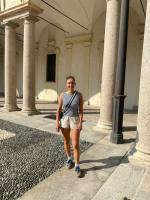
I arrived in Pavia, Italy, fresh from a summer at a language school in Salamanca, and it showed: Spanish kept ambushing my Italian at the worst possible moments. As I enthusiastically deployed my 'Spitalian' on locals and new friends alike, I'd catch the corners of their mouths curling up with each Spanish word that escaped me. My real linguistic slip-up came just days later, though, as I was torn from my slumbers by a harrowing knock at my door. “È la polizia” they called out, as I stood there half asleep in my pyjamas. This is what happens when you don’t submit your permesso di soggiorno, I thought to myself, furious that my procrastination had led to such grave consequences. I desperately tried to answer their muffled questions… When did I arrive? Do I even speak Italian? I rushed to send a text to a friend in Collegio, hoping for clarity on the unexpectedly proactive approach to bureaucracy in Italy… She was initially concerned… then very amused. Lesson number one learnt on my year abroad: la pulizia ≠ la polizia. Had I opened the door sooner, this would have been immediately obvious, not least by the bucket and mop they wielded. This was not the first impression I was hoping to make in Collegio, or in front of the pulizia (in Oxford terms: the scouts). Nonetheless, it was an incredibly useful impetus for me to begin the arduous endeavour of acquiring my permesso di soggiorno or Italian residence permit (spoiler alert: I finally picked up my card just last week).
So how did I end up in this quasi-Oxford scenario? Thanks to St Hugh’s exchange with Collegio Ghislieri at the Università di Pavia, I have had the privilege of spending the year studying at one of Italy’s oldest and most prestigious collegi di merito. Touring Ghislieri for the first time with my parents (and my huge 23kg suitcases), we couldn’t believe my luck. A room with a view indeed (and a cinema room, balcony, extensive library and gym…) Beata me!
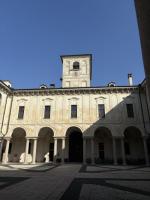
As I settled in, I realised my greatest blessing wasn’t any of these things, but the lovely Ghislieriani who welcomed me, ‘Spitalian’ and all. The other exchange students and I were quickly inducted into the Ghislieri pace of life, central to which is the after-lunch coffee, enjoyed in the glorious sunshine of the piazza or in one of the huge dormitories which look out across the quad. Adapting to the “dolce far niente” was a strange kind of liberation; it was as if I had exchanged the old currency of life, measured out in essays finished and tutorials survived, with a new, less timebound one. So, I began to value my days by conversations had, words learnt, new places discovered, and books finished, perched in the sunshine on the terrace. C
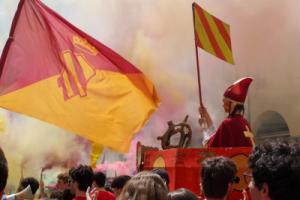
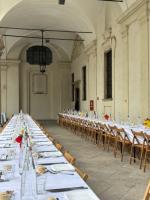
Such tranquility, at Ghislieri, never lasts long. I found myself swept up in the chaos of college life: joining sports teams, celebrating Italian holidays with regional dishes, dancing, and parties I could only really describe as Italian BOPs. Just this weekend I attended Ghislieri's San Pio celebrations: a long, beautiful lunch set out under the porticoes, followed by the full theatre of Italian college life. Freshers (matricoli) received their college pins while being heckled with songs by the older years and the fourth years directed a melodramatic satire of college life, which even included parodies of the Rettore. Then came the fantastically ridiculous Caccia Intercollegiale, a sort of citywide sports day in which the matricoli race across Pavia visiting each collegio completing challenges, preceded and ended by a cinematic ceremony of floats and a sea of college colours. There is something rather special about watching a place's traditions from the inside, even if only borrowed for a year.
Amid all of this, the year has had its harder moments too, reliably alleviated by Italy's blessed sweet treats, aperitivi, and the conversations that accompanied them. When the days grew shorter and the grey, unforgiving Northern Italian winter arrived, we were comforted by luscious, thick hot chocolates and panettone. Now, as the end draws near, the return of spritz in the sunshine is just enough to soothe the longing for Trinity term and the arcadia of St Hugh's gardens. Sitting out in the piazzas, after all, is its own type of bliss; Jhumpa Lahiri captures it perfectly: "Lo scenario assomiglia a una festa spontanea, la piazza trasformata in una spiaggia in cui circola un senso di ebbrezza, di benessere.” Reading, too, has brought unexpected comforts: Italian literature and life have cast light on each other in ways I couldn't have anticipated. Trying out vocabulary gleaned from Lahiri, Ginzburg, and Ferrante on friends in college has been a particular pleasure, their confusion as to where I found such words being rather telling of my reading tastes. That, alongside the long list of regional phrases garnered from the Ghislieriani, will make for some interesting translations when I return to Oxford!
These small anchors, food, books and friends, matter more than they might seem, because the year abroad is, beneath its surface, a quietly disorienting experience. After all the planning, tiresome bureaucracy, and worrying, you finally uproot yourself and fall into a parallel reality that leaves you a little dizzy. Even having established myself in St Hugh's Italian counterpart, it is still somewhat startling to experience a period of limbo in a place which is almost familiar, yet still distinctly foreign. For all that, I have come to think that the dizziness is rather the point; that being unmoored, just briefly, is what allows you to consider properly where you’ve landed. It is a feeling difficult to conceptualise beforehand, but one I have found myself returning to with friends scattered across Europe, each of us navigating our own version of the same strange in-between.
And really, if one must be adrift, Pavia, it turns out, is a rather wonderful place to float. All I can do now is soak up what remains: pizza evenings on the terrace, strolls along the Ticino and practising my Italian with whoever will listen (gelato, it turns out, makes a great bargaining chip!) At the same time, I must slowly prepare to leave behind the daily rhythms of life here: sharing coffee, going to conferences, and spending long hours at the mensa (hall) with friends who have, in the space of a year, become indispensable. My Italian, at least, has survived the year considerably better than it began…though with a summer in Spain ahead, I make no promises about the ‘Spitalian’!