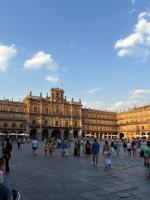
As the end of my year abroad draws horrifyingly closer, it becomes ever more difficult not to reflect on everything that has happened over the past 9 months. A student of Classics and Spanish, I have spent my time living in Salamanca, a city in the Spanish autonomous community of Castilla y León, a few hours out of Madrid, close to the border with Portugal. During this time, I’ve had the pleasure of studying a variety of classes at the Faculty of Philology of the University of Salamanca.
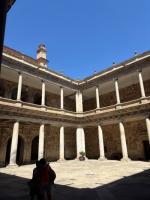
Much like Oxford for English, Salamanca is a city (and a university) which has, since its foundation, always had an impressive influence upon the Spanish language and its literature. It’s quite something to study here knowing that the first ever grammar of the Spanish language was written right in this very city, by an erstwhile student of the university itself. Every time I cross the Roman bridge over the River Tormes, or walk through the Plaza Mayor, I am walking in the footsteps of countless notable Spanish scholars and authors. Not that the university will ever let you forget it – the walls of the Palacio de Anaya, the main building of the Faculty of Philology, are branded with myriad vítores, symbols used to celebrate individuals who have successfully defended their doctorate, in a tradition that dates back centuries. Every time a student makes their way to class, they are reminded of their illustrious predecessors. No pressure!
The city also has a claim to fame as the setting of some important works of Spanish literature. Standouts include La Celestina and the Lazarillo de Tormes, two important Spanish works from the 15th and 16th century, respectively. As one of my Spanish Finals papers, I study Medieval Spanish Literature, so to be able to spend time in the Huerto de Calixto y Melibea, the purported backdrop for a number of important scenes in La Celestina feels both eerie and special at once.
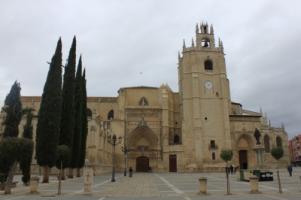
It’s not just in Salamanca, however, that I have felt as if I were walking in the footsteps of Spain’s medieval past. During my time here in Spain, I have also taken the opportunity to explore the country, and I plan on doing some more before I have to return to the reality of final year. One such trip was to Palencia, another city in Castilla y León, and one which is rather underdiscussed by both foreign and Spanish tourists alike, to the extent that its cathedral is known locally as ‘La Bella Desconocida’ (The Beautiful Unknown) on account of its lack of recognition. Yet it was in this cathedral that I came face to face with my own studies.
Last year, as a part of the Medieval Spanish Literature paper, I studied a text known as the ‘Mocedades de Rodrigo’, a poem which serves as a sort of prequel to the ‘Poema de Mio Cid’, which details some of the exploits of El Cid, a lord and knight often considered to be Spain’s national hero. Like all good prequels, the Mocedades plays fast-and-loose with the characters it borrows from the original work to such a degree that El Cid purists have often thought of the poem as of lesser substance, or even disregarded it completely. The text itself begins, not with its main character, but with a run-through of the history of the Spanish kingdom of Castile, with special focus on figures belonging to El Cid’s family tree – a sort of ‘Who Do You Think You Are?’ for the 11th century knight. During this section, the poet dedicates some 30 lines to the refoundation of the Diocese of Palencia, described as having taken place as a result of the sudden discovery of a cave dedicated to Saint Antolín (to this day patron of the cathedral) by a horseback King Sancho, who then vows to establish the diocese, lost in the wake of the 711 invasions of the Peninsula, once more. All of this had made up an interesting point in my essay on the subject, but, I must confess, had rather slipped to the back of my mind in the intervening months. So, when, having entered the crypt of Palencia Cathedral, I was confronted with a sign detailing a very familiar story and I realised I was standing in the very cave that I had read about all those months ago in my room in Oxford, I was struck by a sudden flash of recognition. All of a sudden, this event that I had spent a week or so considering back in Trinity was no longer abstract, but very real, and I was standing in the very spot where it had taken place. Or so says the legend, at least.
I think that is one of the things that I will most cherish from my Year Abroad here in Salamanca, the fact that it has given a relevance to my study of Spanish that I hadn’t always felt before. Using the language in Oxford is all well and good, but coming here to Spain and having the opportunity to speak it daily in all manner of situations, and not only to speak it, but to hear it all around you, is an opportunity that cannot be beaten. Similarly, the literature I studied had always been engaging and thought-provoking but gained yet another dimension when I found myself in the very situations and environments that both author and audience would have known only too well some 600 years ago. I’m very grateful to have been able to have these experiences, and to take them forward into the future, even though I would quite like to hang around here a little longer.