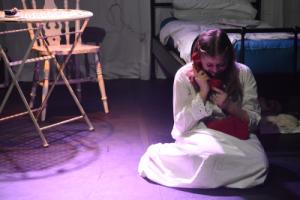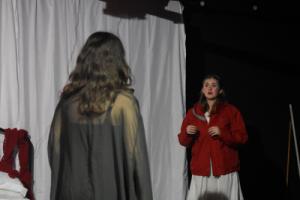
Over the course of this academic year, I have been involved in two projects engaging with theatre and translation. Inspired by Dr Holly Langstaff’s fantastic lecture series on 20th-century French theatre, the first of these was a staging of Jean Cocteau’s La Voix Humaine (1930), in Anthony Wood’s English translation (The Human Voice, 1992), which took place in Hilary Term. The second is ongoing: since Michaelmas, I have been working with a team of translators on a modern reimagining of Rachilde’s Madame La Mort (1891), an experimental symbolist play in which the figures of life and death are cast as two women fighting for the protagonist’s attention. Following a staged reading in Oxford in December and a work-in-progress performance in London in January, the show will be heading to the Edinburgh Fringe Festival this summer, with performances from 24th-29th August at TheSpace @ Symposium Annexe.
As the dramaturg on Madame La Mort, my role has been to bridge the gap between the translation process and the staging process. The most fundamental way in which theatre translation differs from other forms of translation is that it is destined for performance: unlike the literary translator, whose translations are for the private consumption of an individual reader, the theatre translator is working on a script that will be rehearsed and performed by a group of theatre makers. Theatre translations ultimately reach their audiences through the words spoken by actors on stage, coupled with the mise-en-scène of a director and the various artistic decisions of lighting designers, sound designers, set designers and so on. The theatre translator’s work is only the first step in the interpretive process, therefore; several other layers of interpretation will inevitably be added by the theatre makers who stage the play.
I firmly believe that the theatre translator should be considered as one such theatre maker. The ‘translating’ and ‘staging’ of a play are not discrete processes that happen in sequence; rather, they should remain in a symbiotic relationship, each process consistently informing the work of the other. This principle informed how I approached my work on Madame La Mort. From the very first meeting in the writer’s room, I advocated against producing a ‘literal’ translation in the first instance because, as my inverted commas imply, I do not think that such a translation is possible. It is not uncommon in the UK theatre scene to commission a so-called ‘literal’ translation, which is then worked up into a ‘performable’ script by an established writer, who often does not understand the language in which the original text was written (for a more detailed discussion on this, see Geraldine Brodie’s The Translator on Stage, 2017). There are two main problems with this practice, as I see it. Firstly, it presumes that translating and staging can happen separately, treating the translator as little more than a ‘technician’, as Cristina Marinetti puts it; secondly, ‘literal’ translations are presumed to be transparent, acting as clear windows of access to the original text. However, the act of translation means that any such window is always frosted, as even a so-called ‘literal’ translator is constantly renegotiating the boundaries of the source and target languages in their work.
Rather than beginning from a ‘literal’ translation, Madame La Mort originated as a ‘polyphonic’ translation, whereby each person in the writer’s room selected a character from Rachilde’s text to translate, and these translations were woven together to create a first draft. The discoveries we made during this process were invaluable: each person emerged with an intimate knowledge of the French text from an entirely different perspective. This approach also made us realise what we were not willing to lose from the French original, as we decided that we would be doing Rachilde a disservice if we eliminated all of her stunning lyricism in the name of producing a ‘contemporary’ version of the play. Resultantly, a version of the text was born in which the central protagonist was stuck in 19th-century France, while everyone else spoke in a jarringly contemporary vernacular. During the rehearsed reading in December, we started to work with a new protagonist, ‘Juliette’, who uses Rachilde’s ‘Paul’ as a framework to cope with her crippling anxiety, constructing an imaginary French salon in her small student flat. This character allowed us the space to nod to Rachilde’s own gender ambiguity, whilst also helping us to find an authentic place from which Rachilde’s symbolist figures might speak to our world today. Throughout the rehearsal process for the London run in January, I mediated between the director’s vision and the French text, often editing and re-translating scenes in the room to try and find solutions to problems that arose. As both a dramaturg and a translator, I saw my responsibility as lying first and foremost with the translated nature of the play we were putting on: I was consistently aiming to create a text that worked for an English audience while honouring its French origins.
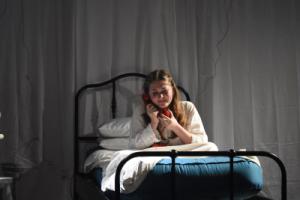
Foregrounding translation was also my primary aim in directing Cocteau’s La Voix Humaine back in Hilary Term. The play stages a one-sided phone call between an unnamed woman and her former lover, over the course of which she learns that her former lover is set to marry someone else the very next day. The text is a monologue, usually performed by just one actress. In my production, I cast The Lover on stage in a French speaking role, in order to represent the process of translation live on stage. The play turns around an exploration of communication barriers and technology, and is littered with moments of desperation when the phone line starts to break up. These communication barriers are not just thematic, though: they are the very reason that Wood’s translation of Cocteau’s text exists, and this fact was the basis for all of my directorial decisions. My version of La Voix Humaine was a conversation between the English and French texts of the play, which aimed to remind the audience that they were watching a play in translation.
In the words of theatre translation scholar Marguerita Laera, ‘everyone needs to look beyond their own way of conceptualizing the world through theatre’. As I see it, emphasising the translated nature of translated theatre helps us to do just that.