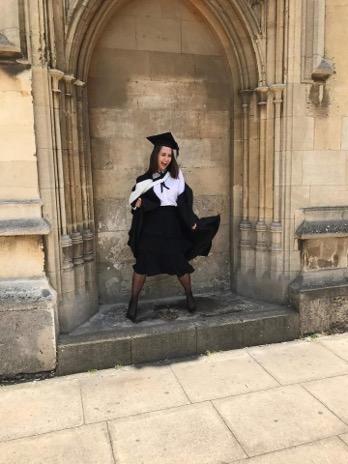
Though she is in many ways a natural linguist—she took French A’ level and Spanish GCSE, as well as an additional GCSE in German which her school did not teach—Rosie Gaunt had not intended to read Modern Languages at University. She applied for Classics and remembers her teacher asking the Oxbridge hopefuls ‘Which of you has a book in their bag ?’ before saying to those—including her—who had raised their hands: ‘You are the most likely to get in!’ The prediction was accurate and Rosie still believes that the implicit recommendation to read widely is the best possible advice you could give someone thinking of applying.
Before coming up to university, Rosie spent a gap year in Modena, au pairing with a lovely family, learning basic Italian from scratch and discovering the local culture. Back in Oxford, after a term as a classicist, she realised that she was missing Italy and languages desperately. She went to see Ela Tandello, the Fellow in Italian at Christ Church, and asked to switch to Italian and Latin. She has never looked back. She enjoyed the breadth of the course, the way in which a languages degree brings in disciplinary diversity, and loved the literature. She has a great fondness for Calvino. Reading him was one of the high points of her course as was studying Dante or getting to know Sicilian literature, including Il Gattopardo. The everyday Italian picked up (with an Italian boyfriend) during her stay in Modena helped Rosie steal a march on other ab initio students. She remembers the small Italian cohort and the cross-College encounters her dual degree helped bring about with great pleasure. She remains close to several contemporaries and they still take trips to Italy together.
Aside from studying, during her time at Oxford, Rosie was a regular at Freud’s on Walton Street for the live music and took long walks in Christ Church meadow but also along the Thames. She was fashion editor at Cherwell and spent a wonderful year out in Milan as an intern with glossy magazine L’Officiel Italia. She was there to deal with comms and digital content. Thanks to a manager who spotted her various talents, she was also given chances to write articles, interview designers, and represent the magazine at events. To supplement her income, she had an Erasmus grant and taught English. One of her closest friends is someone who was then a viticulture student in search of an English teacher and now works in the wine industry in Bordeaux.
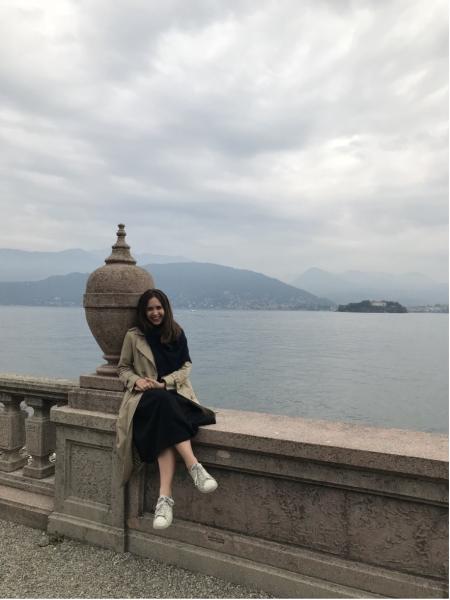
Rosie took her finals and decided to find a way back to Milan, probably, she thought, to become a journalist. A brief stint in her local Marks and Spencer made her realise how much consumer waste could and should be avoided. She developed an interest in sustainability which has never left her. To return to Milan, she took a job with YOOX NET-A-PORTER GROUP, an online high-end fashion outlet. Her Oxford degree and the fact that she spoke Italian were decisive factors in her recruitment by founder Federico Marchetti. She was the only British member of the team in Milan and helped develop Comms and special assignments, in particular the six-year-long ‘Modern Artisan’ project which she created and led, from setting up training programmes, to seeing end-to-end development, design and production. The project brought together 30 students from the UK and Italy over three editions, bridging the gap between design degrees and working in the fashion industry via a collaboration with producers of natural fibres and dyes etc. Recreating a British wool supply chain—along with providing then unheard-of digital passports for the products—were some of the sustainability innovations piloted. As Rosie stresses, we tend to forget that fashion is an agricultural business with many raw materials coming from the ground. The Modern Artisan project was developed in partnership with and supported by The King’s Foundation, with the students welcomed to Dumfries House by the then Prince of Wales (https://www.royal.uk/clarencehouse/modern-artisan-project). A spread in Vogue and a series of beautiful films celebrated what had been achieved.
Rosie returned to the UK when COVID struck but continued to manage the project from London. After six years with the firm, Rosie was keen to seek a new challenge. She joined luxury shoemaker Manolo Blahnik in May 2024, where she is now Senior Responsibility Manager. She stresses that ‘Responsibility’ is one step further than ‘Sustainability’: we have to be aware of the consequences of our actions. Rosie looks at emissions, animal welfare, biodiversity, social and ethical policies, the supply chain, the care and repair of products. This means meeting new challenges every day as there is no single discipline involved. Rosie sees herself as helping the change to better relations with the world we live in. ‘We’re part of a polluting system. How can we make things better?’ she asks.
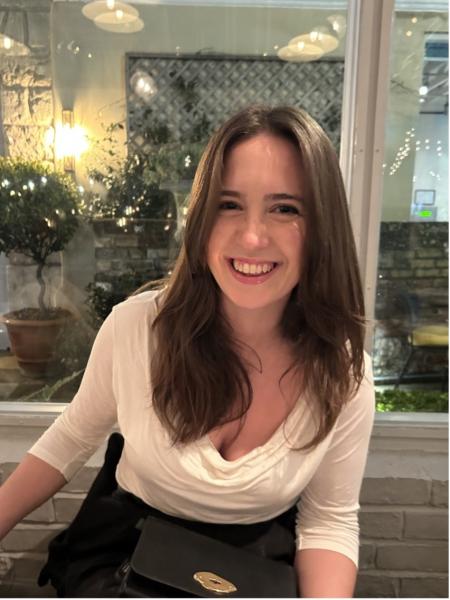
Manolo Blahnik’s factories (except the Spanish espadrilles maker) are in Italy so Rosie uses her Italian regularly and her linguistic skills were a big factor in her recruitment. She jokes that her vocabulary has expanded exponentially in the field of shoes. She is enjoying bringing the discussion of topics like sustainability to traditional manufacturers in Italy. She is learning to understand the craftsmanship and says it requires exactly the skills she developed during her studies at Oxford: ‘Breadth, analytics, details, mostly the empathy, curiosity, understanding others. The desire to do so. Flexibility and imagination. Openness, the ability to imagine and build different systems and structures.’ Literature, she says, has been a great help all along as it means you are in the habit of thinking yourself into another’s place.
Rosie admires the spirit of Manolo Blahnik. Mr Blahnik is a great believer in the humanities. He has loved Marie-Antoinette since he was a child and designed the shoes for Sofia Coppola’s film. Manolo Blahnik was the exclusive sponsor of the recent V&A exhibition. His interest in history, arts and literature is shared by his niece the CEO, Kristina Blahnik who established the firm’s archives, something few similar companies have carried out so fully: knowledge of the past is vital to face future challenges. Supported by Manolo Blahnik, Rosie has set up a social enterprise. The Rest of Nature is an educational advocacy organisation. It gives free workshops to schools, funded through training corporate clients. The message is clear: the climate crisis is first and foremost a crisis of communication. ‘What do I need to tell people?’ Rosie asks. ‘We are part of nature, in constant relationship with nature. The root cause of the climate crisis, social unrest, discrimination… is that we are cut off from nature. It is a simple message that can shift sustainability communication and education from anxiety and asceticism to a place of abundance.’ Awareness, she believes, can help us to move things towards making the world a better place.
Storytelling, imagination and languages all remain vital for Rosie. She works in the luxury sector but recalls spending time at Oxford, reading extraordinary books and thinking about ideas with experts in the field as a real luxury too. Languages, she says, have helped her to create economic value. At a time of crisis, she observes, we need the brightest minds who have been trained to understand the importance of curiosity, interest and imagination, who can make connections—people, she adds, ‘just like Oxford Modern Linguists’.