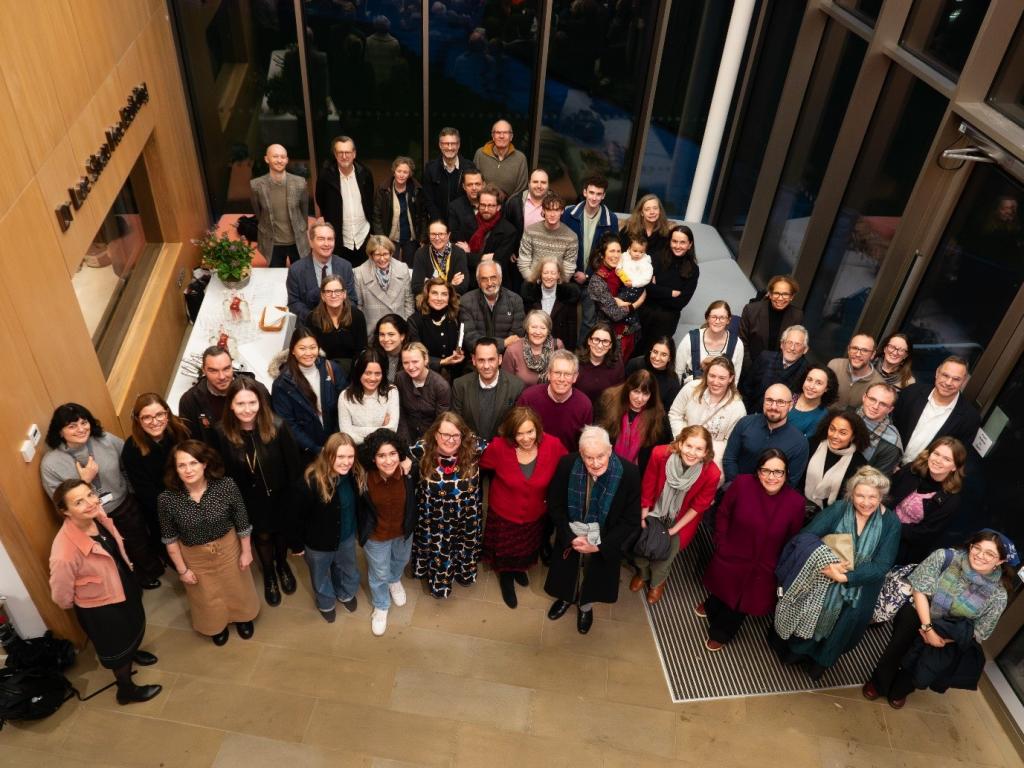
On 5 December 2025, Wadham College hosted an event to mark the achievements of Professor Cláudia Pazos Alonso on her retirement, which marks the end of an era in the teaching of Portuguese at Oxford. Her appointment, in 1997, to a Lectureship in Portuguese and Brazilian Studies, enhanced the range of teaching expertise that could be offered by the Sub-Faculty. She brought diversity to the syllabus, including a whole range of women writers from across the Portuguese-speaking world, and launching the first African Studies Paper XII in the Faculty, in 2000. At Divisional level, too, she became involved in the running of the MSt in Women’s Studies.
Cláudia was only the fourth woman elected to a Fellowship at Wadham College, where she went on to hold important roles, such as Dean and Tutor for Women. Students and colleagues will remember visiting her office: two flights up an ancient, creaky wooden staircase, with views of the front quad and the Fellows’ Garden.
Alongside her teaching and her college duties, Cláudia is a world-renowned specialist in Portuguese Modernist poetry, nineteenth- and twentieth-century print culture (women’s journalism), Portuguese women’s writing in general, Afropean literature. She has published seminal studies in these areas, and many more. She has organised numerous conferences that have stimulated research and publications, making sure that younger scholars could present their work alongside that of more established ones. To name just a few, the Jornadas (Day Conferences) of the 1990s and 2000s, devoted to specific authors, Transnational Portuguese Women Artists (2017) and ‘Unfinished Revolutions in Portuguese Literary and Visual Culture’ (2024).
Cláudia has also done much at a national and international level to promote Portuguese as an academic subject: she is a founder member of ABIL, the Association of British and Irish Lusitanists, she has served as Vice-President of the International Association of Lusitanists (AIL), she has worked tirelessly in crucial ‘behind the scenes’ roles, as external examiner, reviewer of manuscripts and articles, evaluator of grant applications and member of selection panels. She has been a devoted tutor to her students at Oxford and continues to be a stalwart supporter of young researchers starting out in academia.
The event held on 5 December brought together friends and colleagues, students past and present, from near and as far as Brazil and the USA, to share their memories of Cláudia from different perspectives.
[1] See the report on the Faculty website: https://www.mod-langs.ox.ac.uk/events/2017/03/16/transnational-portuguese-women-artists-conference
[1] See the report by Maria Pereira Branco in The Oxford Polyglot: https://www.mod-langs.ox.ac.uk/oxford-polyglot/2023-24/trinity-term-2024/unfinished-revolutions-portuguese-literary-and-visual
After heartfelt tributes from Olivia Vázquez Medina and Jane Garnett (representing Wadham), Luis Gomes and Simão Valente (recognising Cláudia’s contribution to shaping the field of Portuguese in the UK), Tom Earle and Toby Garfitt (her former tutors at Oxford), Olivia Glaze (a former doctoral student), Ana Luísa Vilela and Luísa Coelho (acknowledging her role as collaborator in research and co-editor) and, lastly, Pelagia Goulimari and Hilary Owen (celebrating Cláudia’s championing of women’s rights and women’s writing), Cláudia herself spoke movingly about the highlights of her career. Some aspects of her character were mentioned again and again during these warm tributes: generosity, wisdom, kindness, courage, intimidating brilliance, intuitiveness, empathy, comforting erudition, integrity, a personal and professional role model, dedicated to students. Former student Olivia Glaze’s speech culminated in gratitude: “Thank you, Cláudia, for being our anchor and inspiration. You have shaped all of us for the better.”
A final guest speaker, Fabio Mario da Silva, presented a short paper touching upon some of Cláudia’s best-known publications and some of the authors she has studied: the modernist poets Florbela Espanca and Judite Teixeira, and the nineteenth-century authors Ana Plácido and Francisca Wood (whose forgotten novel Cláudia discovered in the British Library). His accolade ended with a summary of Cláudia’s achievements:
We can see a pattern here: the consistent alienation, disparagement and silencing of women writers, exclusion from the canon and erasure from history. Cláudia is a steadfast defender and supporter of women’s rights who is determined to give women writers the recognition they deserve. Her work, over the decades, has revealed how literature and the processes of reading, literary recognition and critical positioning intertwine with the very nature of existence and being a woman. As an intellectual based at one of the most prestigious universities in the world, Cláudia has foregrounded the voices of women writers that question the status quo and show their readers just how unjust our society is in relation to issues of gender.
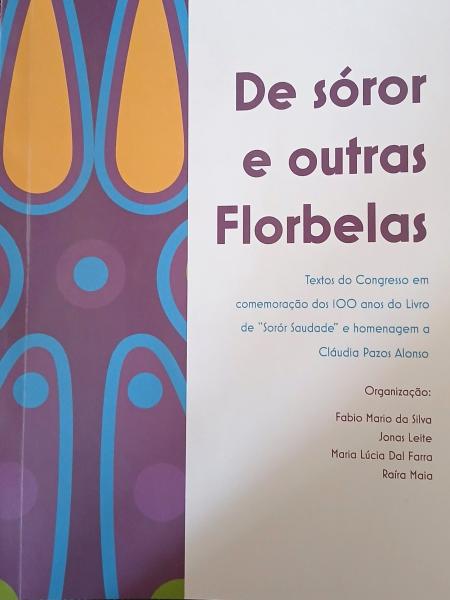
Fabio also presented the University with a copy of a volume of essays commemorating both the centenary of the publication of Florbela Espanca’s first book of poems and marking Cláudia’s retirement. The book is entitled De sóror e outras Florbelas: textos do Congresso em comemoração dos 100 anos do livro de “Sóror Saudade” e homenagem a Cláudia Pazos Alonso, and it is available as an Open Access publication: https://www.editora.ufrpe.br/node/413
After a last speech by Robert Hannigan, Warden of Wadham, the event continued more informally with a drinks reception and many more conversations and reminiscences.