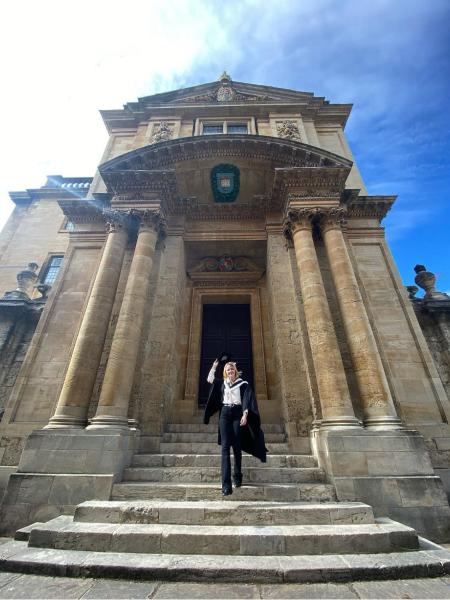
As anyone who read Modern Languages at Oxford will know, there is no such thing as a standard student. They are all unique in their own ways. Pauline Lemaire, who is now established in Geneva, working for renowned private bank Pictet, certainly proves this point. Born in France, she lived in Singapore until she was 11, spent a couple of years in Morocco and one term boarding in the UK, then in France, before attending a French lycée in Singapore. Her major for the baccalaureate was economics, and her minor mathematics. Her parents thought there was no future in literature (her favourite subject) and she applied to Oxford without even telling them. After nearly missing the deadline for the admission test (on her birthday), she was laidback at her interview as she thought she had no chance of getting in, and viewed it more as an opportunity to have a conversation with experts in a topic that she was passionate about. Fortunately, both for her and for Oxford, she was offered a place at St Hugh’s to read French and Philosophy.
Pauline enjoyed the atmosphere in college. She describes it as a very friendly place with a proper family vibe, most students living in and lots of socialising between the different years. She made lifelong friends who are now scattered across different countries including Poland, Portugal and England. She remembers spending time with them on the lawns at St Hugh’s, but also on Little Clarendon Street (usually at Gail’s or in the wine bar), drinking great cocktails at Kazbar and reading in the Library at All Souls, in Duke Humfrey’s and in the Taylorian. These libraries, she says, are some of her favourite places in Oxford (or even the world!) She organised very popular wine and cheese evenings for the French club and remembers the quality of the company as far superior to that of the booze!
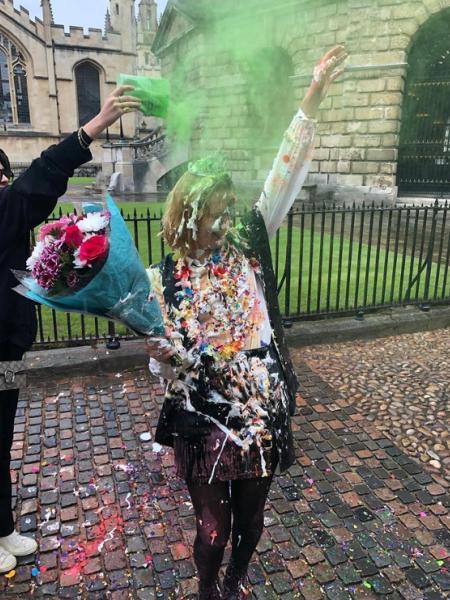
During her degree, Pauline loved specialising on authors. “Duras, Baudelaire… I read everything they wrote.” And she still can’t believe how lucky students are to have one-to-one tutorials: “It is so precious to have an hour with a world specialist”. The course in French was at once rigorous and encyclopaedic, teaching students how to be critical whilst letting them be more creative than in France where she spent an enjoyable year abroad as a marketing intern at HEC Paris and then at the ENS in Lyon. Towards the end of her degree, Pauline was increasingly feeling that philosophy too often had an inhumane way of looking at humane goals. She was aware that the importance of defining words and the transferable skills she had acquired studying modern languages meant she was particularly open to approaches adopted by anthropologists—of whom there were several in her circle of friends. She sensed for instance that there was something tribal in the way her younger sister’s circle of friends used words and the particular way they spoke them. She decided to undertake postgraduate studies in digital anthropology at UCL. She used her knowledge of social media and networks providing content creation services for start-ups but was still unsure of where she would like to live, or what sort of career path she might follow.
With her Master’s degree under her belt, Pauline had not decided what she really wanted to do. She applied for 50 or so jobs without being particularly convinced by any of them. She did not want to work for people she did not admire, intended to avoid routine and hoped for an intelligent boss. She accepted a position in Lisbon where one of her close friends she met at Oxford was living. Shortly before she upped sticks to move to Portugal, an advertisement for a Family Governance Advisor at Pictet popped up via LinkedIn. She was intrigued by what she read and, though she thought it unlikely her application would be successful, she suspected the role might be right up her street. After interviews online and in person in Switzerland she was offered the job four years ago and has never looked back. She works with wealthy families from around the world to map their culture, dynamics and values. She then helps them to clearly articulate their objectives (which is easier said than done!), and gear their ecosystems towards achieving said goals.
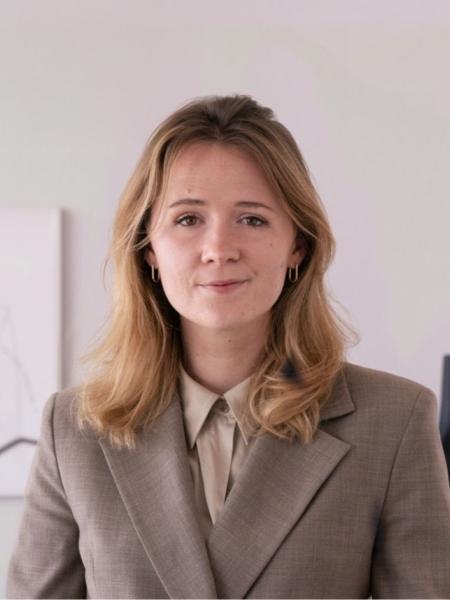
Now happily settled in Geneva, Pauline is clearly appreciated at Pictet where her capacity for analysis and thinking outside the box as well as her soft skills, particularly in terms of cross-cultural communication, stand her in good stead. She is now a Certified Wealth Manager Advisor (CWMA), and has learned all about different asset classes, portfolio allocation and optimisation, and behavioural economics. She credits Oxford with teaching her how to work efficiently, especially when you need to be capable of synthesising hundreds of pages. She thinks her Oxford degree has acted as a real passport for her, opening doors in professional terms: ‘Being an Oxford graduate in the humanities is a testament to one’s ability to synthesise information and to communicate effectively’. As to her advice to current or future students? It is short and sweet: ‘Enjoy your time. Lean into the culture.’