Keynote speakers: Prof Chloë Taylor (University of Alberta) and Dr Kaori Nagai (University of Kent)
Roundtable with Queer Kinship Network led by Prof Charlotte Ross (University of Oxford)
Organising committee: Dr Fanny Clemente (University of Oxford), Dr Greta Colombani (independent scholar), Dr Cécile Bishop (University of Oxford)
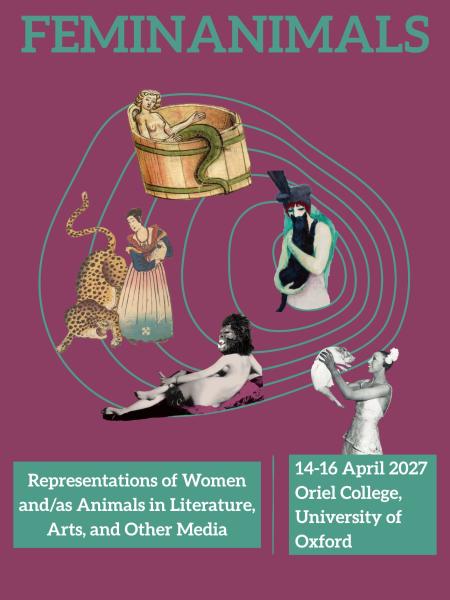
FEMINANIMALS is a three-day international conference investigating representations of women as non-human animals and of the relationship between women and non-human animals in literature, arts, and other media across languages, from medieval to contemporary times.
Across time and space, literature, arts, and other media have been pervaded by portrayals of women as/and animals, from the moralistic, religiously informed intertwining of gender and species in medieval bestiaries to the countless retellings of the legend of the half-human half-snake Melusine in texts like Jean d’Arras’s Mélusine (ca. 1393), from the woman-animal erotic unions and shapeshifting in the late seventeenth- and early eighteenth-century supernatural tales Liaozhai zhiyi by Pu Songling to the numerous poems dedicated to wild, exploited, or domesticated animals by Romantic and Victorian women authors, from Odette’s transformation into a swan in Pyotr Ilyich Tchaikovsky’s ballet Swan Lake (1877) to visual depictions of woman-animal entanglements in the surrealist works of Leonora Carrington who identified as a “female human animal”. In more recent times, one could mention Clarice Lispector’s novel A paixão segundo G.H (1964), Marie Darrieussecq’s satirical tale of a woman’s metamorphosis into a female pig in Truismes (1996), Nnedi Okorafor’s Africanfuturist speculative novel Who Fears Death (2010), and Athina Rachel Tsangari’s films Attenberg (2010) and The Capsule (2012). The conference will examine what these pervasive representations of women as/and animals in different cultures and historical periods can tell us about shifting notions of gender and species, the fraught line between humanity and animality, and the entwined practices of domination and othering to which women and animals have been subjected.
We encourage proposals considering works belonging to different media and genres, focusing on canonical as well as noncanonical authors and artists, and dialoguing with diverse theoretical and methodological approaches, such as human-animal studies, posthumanist studies, new materialism studies, ecofeminist studies, animal studies, critical animal studies, animality studies, gender studies, critical race and postcolonial studies, queer studies, psychoanalytic and post-structural studies, affect theory, and other relevant fields of inquiry. Papers may explore topics including, but not limited to: women-animals metamorphoses; women-animals hybrids; women, animals, and the body; women, animals, and sexuality; women, animals, and gender; women, animals, and race; women, animals, and class; women, animals, and motherhood; metaphors of women as animals; women, animals, and language; kinship between women and animals; women, animals, and ethics and aesthetics of care; women, animals, and the environmental crisis; women, animals, and science; women, animals, and spirituality; women, animals, and folklore; women writers/artists and animals; trans women and animals; women, animals, and the male gaze.
Please note that the conference will take place in person in Oxford with no possibility for hybrid participation. There will be no conference fee. All presentations should be in English and last no longer than 20 minutes. Proposals, including title, abstract (250 words max), and short bio (150 words max), must be submitted via email in a single Word document to
frances.clemente@oriel.ox.ac.uk and greta.colombani@gmail.com by 15 July 2026. Notification of acceptance will be sent by 30 July 2026. Please feel free to contact the organisers Dr Fanny Clemente and Dr Greta Colombani at any point for inquiries and further information.