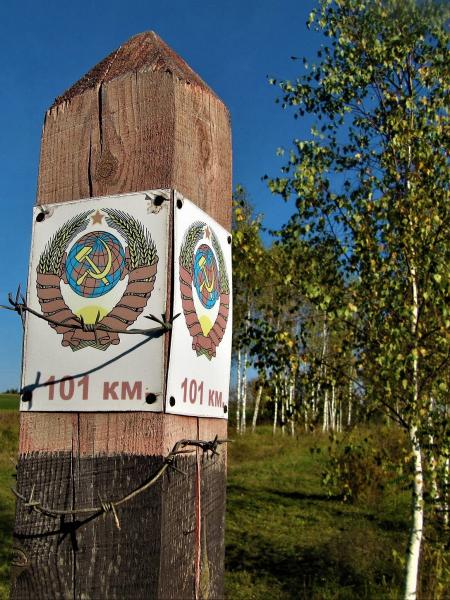
Prof. Polly Jones (Slavonic) has been awarded a three-year Leverhulme Research Project Grant (£384,000) to fund the collaborative project 'The 101st Kilometre: Soviet marginalisation, migration, memory and mapping'. The grant, one of only eight awarded to humanities projects across the UK in the March 2026 round, will fund research across four countries by the PI (Jones) and Co-i (Dr Miriam Dobson, Sheffield), two post-doctoral researchers, the Ukrainian historian Tamara Vronska, and the Latvian writer Guna Roze.
From soon after the 1917 Bolshevik revolution up until the system’s 1991 collapse, the Soviet authorities barred various ‘undesirable’ populations from key cities and surrounding zones: dissidents, former political
and criminal prisoners, certain religious believers, sex workers, the homeless and unemployed. The edges of these protected metropolitan zones were (and remain) widely known as the '101st kilometre'. But were these spaces of banishment and dumping, or escape, refuge, even freedom? How did marginalized citizens navigate their invisible borders, and what kinds of communities, collective action and commemoration emerged from their migration and settlement? The project team will undertake the first interdisciplinary, analysis of 101st-kilometre urban exclusion, migration, community–building, and commemoration, comparing Ukraine, Latvia, Kazakhstan, and Russia. The research will encompass physical and digitized archival and museum materials, and will analyse a multilingual, multi-media corpus of memoir and artistic narratives. The result will be the first book-length account of the 101st kilometre, and a digital atlas mapping this diverse, vibrant territory throughout the 20th century.
https://www.leverhulme.ac.uk/listings?field_grant_scheme_target_id=15 ; https://www.mod-langs.ox.ac.uk/research/101st-kilometre-soviet-marginalization-migration-memory-and-mapping