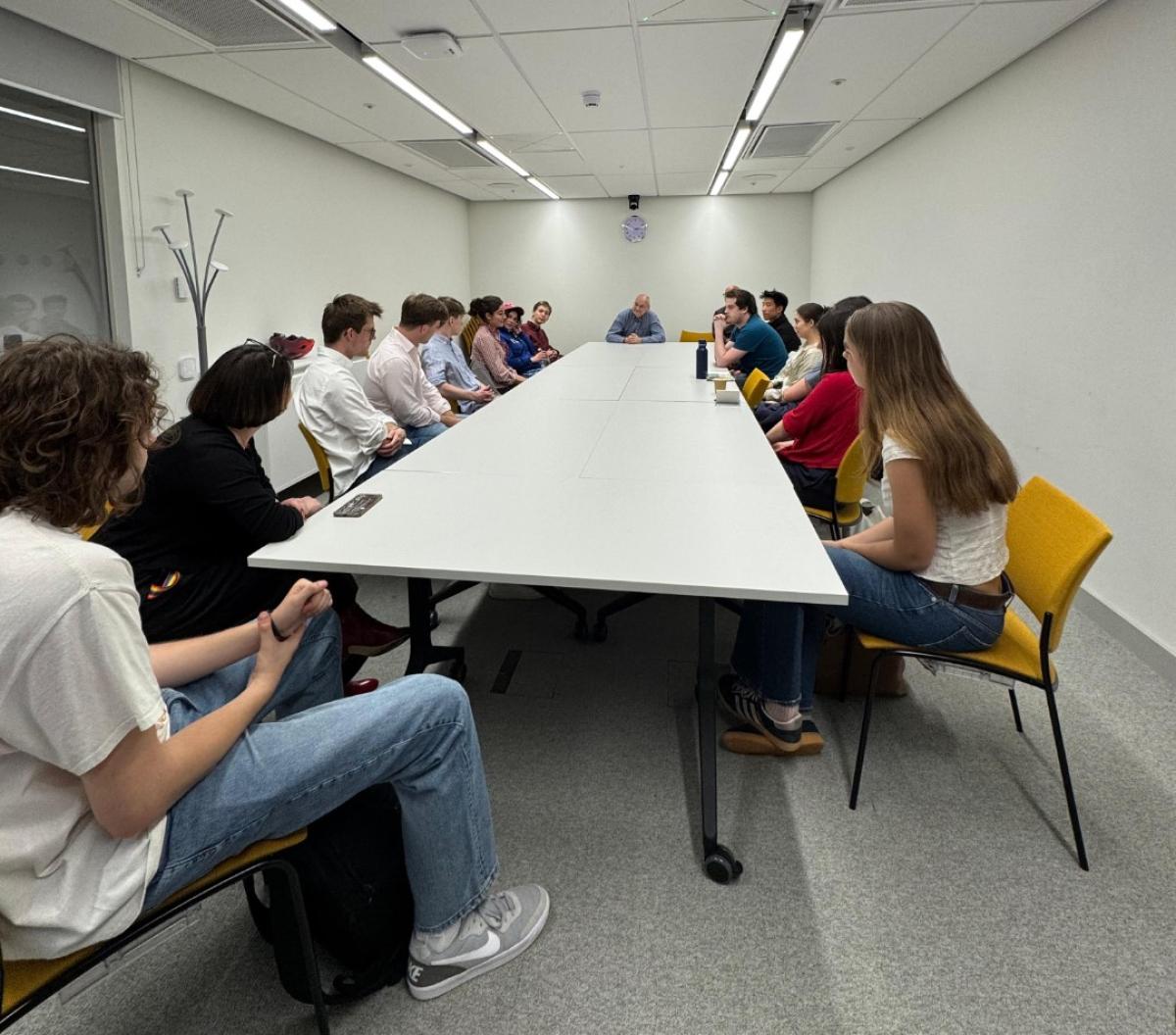
On the first Monday of Trinity Term, we were delighted to welcome His Excellency, the ambassador of the Czech Republic to the UK, Václav Bartuška, who met undergraduate and graduate students of Czech for a wide-ranging and thought-provoking Q&A at the Schwarzman Centre for the Humanities.
The ambassador began by asking about the different languages that students were combining with Czech (currently French, German, Polish, Russian and Spanish) and, as a keen learner of languages himself, praised their decision to pursue modern language studies. He recalled the Czech saying ‘Kolik jazyků umíš, tolikrát jsi člověkem’ (‘The number of languages you know equals the number of times you are a human being’), often attributed to the early modern Czech writer, Jan Amos Comenius, and noted from his professional experience how much the skills the students are acquiring would be needed in the world of today and tomorrow. A student who had worked in a Czech grammar school during his year abroad recalled how most students there were studying at least two foreign languages to an advanced level. In response, the ambassador pointed out that internationally this situation was normal, and it was the British school system that was regrettably out of step.
He was curious to know what the students found most difficult about Czech. For First Year beginners, the answer was declensions - the fact that ‘every word in a sentence seems to need to change depending on what it is doing’. The finalists nominated syntax, especially word order, while graduate students felt the richness of Czech vocabulary remained the ultimate challenge.
The ambassador responded self-deprecatingly to questions about his role as one of the leaders of the student strikes at Prague University in November 1989 that triggered the demonstrations that brought down the Communist government in Czechoslovakia. He explained that other students had made him a leader only because he had already been arrested and threated with three to eight years’ imprisonment, so his life was already ‘screwed’ (he used a different word!) He observed that most such rebellions – including very recent ones – end in failure and death, and he and his friends were fortunate that the Czechoslovak Communist government could no longer find people willing to kill for them. He spoke admiringly about the experience of working closely with Václav Havel, the first post-Communist president, and noted that it was no accident that the anti-Communist opposition was led by a playwright, who in the absence of free speech and a free press had used imaginative literature to uncover the flaws in Communist society and ideology.
When asked about his current work, the ambassador made no attempt to hide what he perceives to be profound threats to our security and way of life. He pointed out that the Russian invasion of Ukraine had prompted both the wholescale militarization of Russian industry, which demanded a response from NATO countries and others, and a rapid transformation in strategic and technological approaches to contemporary warfare, where the West was now lagging. As a voice from East-Central Europe, with a living memory of occupation and unfreedom, he plainly sees it as his role to shake what he perceives as a misplaced complacency in the UK and other Western countries that our freedom and prosperity will last forever. He remarked that history shows Czechs that they are rarely free or independent for very long; their priority is to survive and to ensure that if another Iron Curtain falls in Europe, they are on a different side from last time.
Whether ambassadors or teachers, in conversations with students, we can be guilty of avoiding discussion of the huge challenges facing the world, conscious of everyone’s mental health and the need to have spaces where we can escape or imagine better worlds. It was a measure of how seriously Ambassador Bartuška took our students, their intelligence and their potential to influence the future world that he was prepared to set out his analysis so starkly to them, and his visit will not be quickly forgotten. It was excellent in the margins to discuss with the ambassador and third secretary the Czech programmes at Oxford, the varied motivations of students and our successes in public engagement and research activity, and to receive their warm expressions of support and practical encouragement, including offers to host our students at events and during an ordinary working day at the embassy. We hope to see them here again very soon!
Rajendra Chitnis
Associate Professor, Czech and Slovak
Ivana and Pavel Tykač Fellow for Czech, University College